A snowman, crafted from snow and tree branches, stands in front of Orton Hall after the first substantial snowfall of the year on Dec. 2. Credit: Faith Schneider | Arts & Life Photo Editor
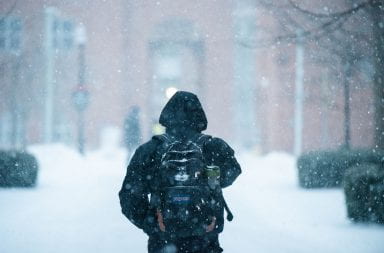
The National Weather Service released a winter storm warning for this weekend, expecting eight to 12 inches of snow between Saturday morning and Monday at noon.
Ohio State has cancelled classes 20 times since 1978 due to severe weather, could Monday be the 21st?
Ohio State went remote last on Jan. 6, 2025 due to expected heavy snow and winds, according to Dan Hedman, a university spokesperson, in an email.
Here are the factors Ohio State considers when deciding to cancel classes.
Ravi Bellamkonda, the executive vice president and provost, decides whether to cancel in-person classes based on gathered information and a recommendation from the public safety team and facilities professionals, according to an Ohio State press release.
Robert Armstrong, the emergency management and fire prevention director, works with different offices around campus to assess factors like road conditions, scheduled events and weather impacts.
“The decision is never black and white,” Armstrong said in the release. “So many factors go into it: the storm timing, whether it’s 9 p.m. or 5 a.m., when the snow is coming in. If it comes in at 9 p.m., we may have time to clean it all up. If it’s 5 a.m., that’s right when people are starting to get to campus, and it makes it a little more difficult.”
Even when in-person classes are cancelled, instructors can move their class online or assign an alternative teaching method, the release said.
When there is a snowstorm in Franklin County, 30 full-time university staff members clear 40 miles of roadway and 140 miles of sidewalk, said Jeff Barr, Facilities Operations and Development’s assistant director of Landscape Services.
“Usually, it will take somewhere between six and eight hours to clear the sidewalks and roadways one time,” Barr said in the release. “We do prioritize some areas over other areas. First and foremost is the Wexner Medical Center, with the patients, visitors, faculty and staff that come in and out of the hospitals. That is a very high priority for us.”
Sidewalks near residence halls and dining facilities are the next to be cleared, Barr said.