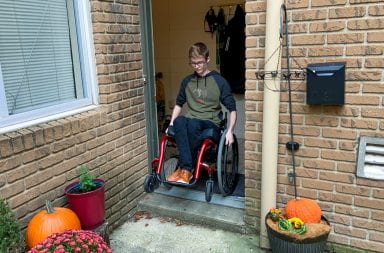
Homes along 18th Avenue on Wednesday where students commonly look for off-campus housing. Credit: Daniel Bush | Campus Photo Editor
Renting an off-campus apartment or house brings various challenges, from finding a decent location to deciding roommate arrangements and figuring out transportation.
It can be a lot to keep track of.
In addition to base rent, smaller monthly costs can add up, causing new renters’ budgets to fluctuate from month-to-month.
For students who may be wary of going through the process of renting for the first time, the Office of Student Life and Student Legal Services offer support for navigating the costs of moving off campus.
Jacob Glorioso, off-campus specialist for Off-Campus and Commuter Student Engagement, said that first and foremost, students looking to make the switch to off-campus living should consider their budget.
“We really recommend [to] students, before they start the off-campus housing process, before they even look for a roommate, know what they’re comfortable affording,” Glorioso said. “We don’t want students to live outside of their means. It’s not a fun experience to not know how you’re going to pay that next month’s rent or that next utility bill.”
From there, students can look at the Off-Campus Housing Network, a well-vetted resource of property owners and management companies that partner with Ohio State and adhere to a list of criteria that includes regular communication with Off-Campus and Commuter Student Engagement. The office asks management companies if leases clearly state terms regarding different issues including parking availability, costs and fees, as well as specification of holding fees, utility rates and renters insurance requirements.
Reading a lease for the first time can cause no small amount of head-scratching, Student Legal Services can help with that, too. By providing lease reviews as part of their off-campus housing resources, students can know exactly what they are going into before they sign.
Lauren Statzen, senior relationship manager with Off-Campus and Commuter Student Engagement said that students should also consider reaching out to property owners directly.
“I would think especially our companies within the Off-Campus Housing Network [would be] more than happy to talk to a student and would rather the student ask questions,” Statzen said.
When finding a roommate, Statzen said that finding someone who is on the same page financially is crucial, especially when it comes to splitting costs like utility and grocery bills.
“A roommate agreement can be a really great tool that they can utilize,” Statzen said. “This is separate from the lease, just students themselves agreeing upon, ‘Okay, we’re going to split water. We’re going to split whatever it might be.’”
The Off-Campus roommate search page, and a sample roommate agreement can be found on the Off-Campus and Commuter Student Engagement website.
Other factors Glorioso said students moving off campus should consider is transportation and parking, not just at their apartment, but also if they require transportation to get to campus, which factors in costs of gas and CampusParc fees.
“[Students] have access to COTA. So [if they] take the COTA bus, [they’re] good there, are [they] going to drive? [That’s] something to consider,” Glorioso said.
Groceries are another consideration if students are leaving a university dining plan. Glorioso said students should think about what a normal grocery budget should look like ahead of time so that they can plan that into their monthly expenses.
Protecting valuables can be an up front expense that can save a lot of financial stress in the event of catastrophe. Renter’s insurance, though not required by Ohio law, is often required by landlords and will be outlined in a lease agreement — this is another area that the Off-Campus Housing Network takes into consideration in its criteria.
Prior Lantern reporting has shown that winter break-ins nearly doubled since last year, and suggests that renters insurance may be a smart investment.
Some leases will automatically enroll a tenant into a basic insurance policy unless it is waived by the tenant presenting proof of an outside renters insurance policy.
More information about off-campus living can be found at offcampus.osu.edu, Student Legal Services housing information can be found on its website.
Off-Campus and Commuter Student Engagement is also hosting the Off-Campus Living Expo on March 24 from 11 a.m. to 3 p.m. in the Performance Hall of the Ohio Union.