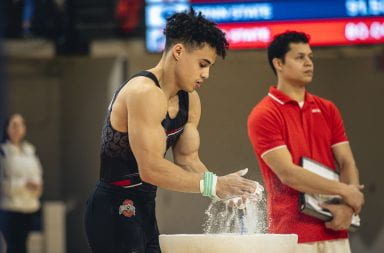
The Ohio State men’s gymnastics team walks into the Big Ten Championships at Crisler Center. Credit: Courtesy of Ohio State Athletics
The gym is silent except for the loud thuds as senior Jacob Harmon pushes off against the mat before taking on the floor, then explodes into his vault routine.
For this gymnast, the movements in his performances have been practiced countless times; still, expectations are high, and he is balancing more than just sticking his landings.
While the crowd sees only elegance and power, it’s the silent, disciplined groundwork that fuels it. For Harmon and his Ohio State teammates, nutrition, recovery and routine have become just as essential to performance as the sport itself.
With years of experience and his current time on the team, Harmon understands the physical preparation it takes to prepare before each match.
“The dining hall that we have has fuel and snack zones,” Harmon said. “In the facilities, they do such a good job making sure that we have access to the nutrition and the fuel that we need,”
He said that he and his teammates also have access to supplements such as collagen, omega three, daily vitamins, including vitamin D.
“I am just eating as much as I can and as much protein as I can,” Harmon said.
At a time where collegiate athletes have to focus on physical recovery as well as mental endurance, nutrition has become a foundation of performance.
From the center mat in the gym, Harmon explained balancing between academics, practice and recovery made it difficult to find a regulated time to fuel.
Harmon said he eventually reached out to nutritionist Melanie Clark for help adjusting his eating schedule and intake.
“I have a really weird schedule, and my time to eat was really weird,” he said.
He explained that he knew he was under-fueling and needed guidance to avoid crashing during the season. With the help of Melanie Clark and others on Ohio State’s nutrition staff, Harmon was able to get his body and nutrition fueling needs aligned.
Registered dietitian Nicolette Mense, from The American DA Administration, said gymnasts can spend up to 20 hours a week training at elite levels, meaning that consistent hydration and refueling of the body are essential for both energy and recovery.
She said if there is even slight under-preparation of either, these athletes could potentially have dizziness, fatigue and loss of focus in and out of competition.
Nutritionist Melanie Clark said elite athletes must continually fuel their bodies with the right ingredients, like yogurt, cottage cheese, hard-boiled eggs, bananas, oranges, apple juice, various bars and other recovery items.
“They’re throwing their bodies in the air and doing some very impressive things,” she said.
Clark said that performance demands that lead to energy depletion can lead to injury.
“If they got an injury, their athletic trainer usually lets me know immediately, and then I can check in on them,” she said.
With specific injury comes strategic nutrient intakes in order for a smooth and quick recovery. A reported concussion will focus on brain healing nutrients, and a bone injury requires individuals to consume greater amounts of vitamin D.
“I think just the recovery piece and healing piece, we’re on top of it right away,” Clark said. ‘Which can make a difference from their healing and recovery. Not only is it important to fuel before and after meets, but if there is a gymnast injury, fueling and nutrition is one major factor in proper recuperation.